

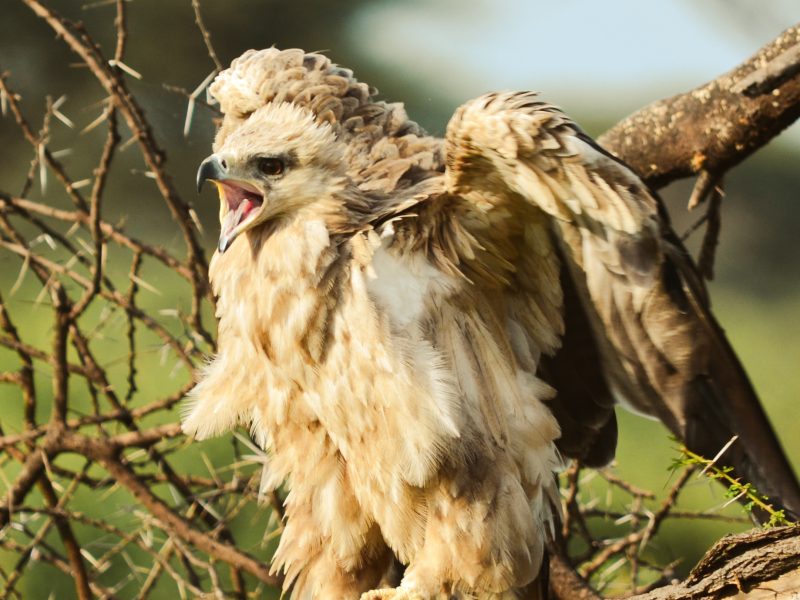

The Tawny Eagle (Aquila rapax) is a magnificent bird of prey often seen gracing the African skies. Known for its rich, varied plumage, this raptor is an adaptable and formidable hunter. The bird species has a varied vocabulary, including yelps, cackles, and yapping sounds, often used during display or when threatened. 

When we picture eagles, we often imagine majestic birds soaring over towering mountain peaks or dense, remote forests. But step into the wild land of the African savannah, the arid steppes of India, or the fringes of the desert, and you will meet a different kind of royalty.

(Aquila rapax)—a rugged, adaptable, and surprisingly cunning raptor that rules the open country with quiet confidence. True to its name, the tawny eagle sports a warm, tawny-brown to rich russet plumage, though its colors can vary widely from pale buff to dark chocolate brown. This earthy camouflage makes it blend seamlessly into the dry, sun-bleached landscapes it calls home.

Weighing in between 3.5 to 6.8 pounds with a wingspan stretching up to nearly 7 feet, it is medium-sized for a true eagle. Like other members of the “booted eagle” subfamily (Aquilinae), its legs are heavily feathered all the way down to its toes, a trait that protects it not only from the elements but also from the bites of struggling prey. While many eagles are specialized hunters, the tawny eagle is the ultimate opportunist. Its diet is remarkably diverse, consisting of small mammals, birds, reptiles, insects, and—frequently—carrion.

It often hunts from an elevated perch or scans the ground while soaring on thermal air currents, swooping down to snatch rodents, hares, or ground birds. It’s even been spotted hunting cunningly alongside grass fires, snapping up small animals fleeing the flames! You will frequently find tawny eagles gathered around carcasses, sharing space with vultures and other scavengers. Perhaps its most entertaining (and cheeky) trait is kleptoparasitism—the art of stealing food. Tawny eagles are notorious for chasing down other raptors, like the Bateleur, and forcing them to drop their hard-earned catches.

Tawny eagles are monogamous, typically pairing for life and returning to the exact same territory—and often the same nest—year after year. Their nests are massive flat platforms built from sticks and lined with green leaves, usually perched high in the crown of an iconic African thorn tree (like an acacia) or, in treeless areas, on utility pylon poles. The female usually lays one to three eggs, but nature can be harsh here: sibling rivalry (known as cainism or siblicide) often means only the strongest chick survives the first few weeks. Once they fledge, the young eagles stay dependent on their parents for several weeks to learn the ropes of survival.

Despite their adaptability, tawny eagles face a troubling decline. Listed as Vulnerable on the IUCN Red List, their populations have taken a hit across their range. Because they are opportunistic scavengers, they are tragically vulnerable to secondary poisoning—often falling victim when they feed on carcasses laced with poison meant for larger predators like jackals, lions, or leopards. Combined with habitat loss, electrical grid collisions, and human persecution, these magnificent birds need our attention and protection.